

The Invisible Threat to Legitimate Retailers
For e-commerce business owners and cybersecurity professionals, understanding the dark economy is the first step in building effective fraud protection. Threat actors no longer just steal credit card data; they operate highly organized supply chains to convert stolen financial data into physical goods.
By analyzing intercepted forum threads from illicit marketplaces, loss prevention teams can understand exactly how carded physical items are fenced and how these stolen goods ultimately undercut legitimate businesses worldwide.
Anatomy of a Carding Supply Chain
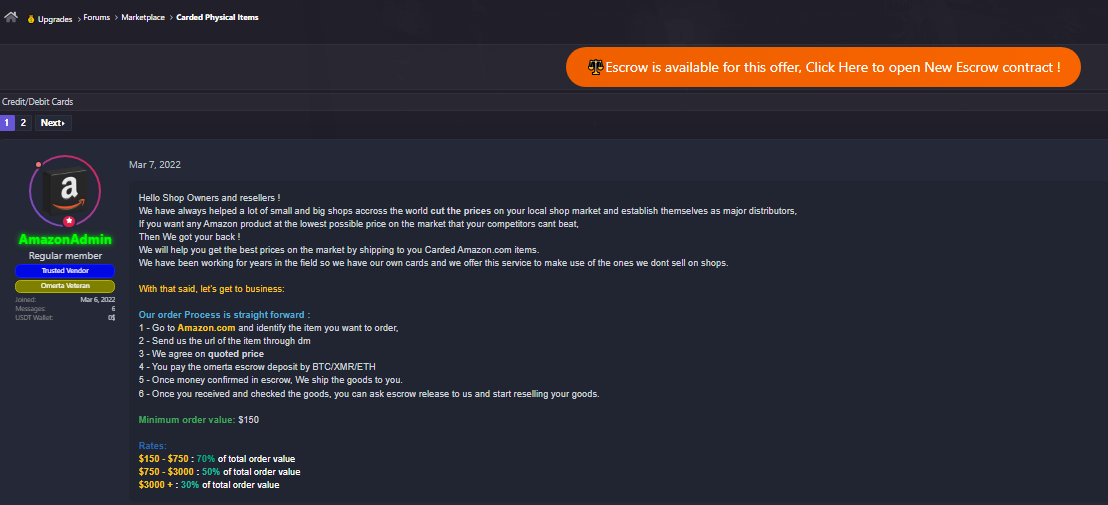
A recent deep-dive into an underground vendor thread reveals a highly structured, six-step process used by threat actors to fulfill orders using compromised credit cards. Understanding this workflow is critical for identifying red flags in your own e-commerce checkout process:
- Target Selection: The buyer identifies a target product on a legitimate site (e.g., Amazon.com).
- Order Negotiation: The buyer sends the product URL to the vendor who controls a botnet or database of stolen card data.
- Quoting: The vendor calculates a “fencing rate” based on the retail value of the goods.
- Crypto-Escrow Payment: The buyer pays a deposit via Bitcoin (BTC), Monero (XMR), or Ethereum (ETH) into an illicit escrow service to mitigate counterparty risk.
- Fraudulent Fulfillment: The vendor uses stolen card details to purchase the item and ships it directly to the buyer (often a criminal reseller).
- Escrow Release: Once the physical goods are received, the escrow funds are released, effectively laundering the cryptocurrency into physical inventory.
The Black Market Pricing Matrix: How Stolen Goods Are Valued
To understand the financial incentive for cybercriminals, we must look at how stolen goods are priced on these forums. Vendors typically use a tiered pricing model based on order volume, essentially creating a wholesale market for stolen inventory:
- Low Volume ($150 – $750): Resellers pay 70% of the retail value.
- Medium Volume ($750 – $3,000): The rate drops to 50% of retail value.
- High Volume ($3,000+): Bulk buyers pay only 30% of the retail value.
This aggressive pricing model allows illicit resellers to severely undercut legitimate local shops and distributors, as they are acquiring inventory at a fraction of wholesale costs.
Scale and Global Reach: Insights from Forum Reviews
An analysis of the user feedback within these forums highlights the massive scale of these operations. Over a multi-year period, threat actors successfully executed bulk orders, including:
- A single $24,000 retail order fulfilled for just $6,000.
- Bulk shipments of high-value electronics (e.g., 27 iPhones in a single order).
- Global fulfillment, with confirmed deliveries as far as Brussels, demonstrating international fencing networks.
Reviews frequently mention “fast shipping,” “tracking numbers provided,” and “replacements for lost parcels,"> indicating a customer-service-oriented approach that mimics legitimate B2B dropshipping.
The Role of Cryptocurrency and Illicit Escrow
The use of Monero (XMR) and Bitcoin (BTC) paired with underground escrow services solves two major problems for criminals: anonymity and trust. Because these actors cannot use traditional payment gateways, crypto escrow acts as a shadow banking system. This makes tracing the financial trail incredibly difficult for law enforcement, allowing the laundering cycle to complete seamlessly from digital currency to physical asset.
Defensive Strategies for E-Commerce Merchants
When fraudsters use stolen cards to buy goods, the legitimate merchant is hit with chargebacks, losing both the inventory and the revenue. To prevent your e-commerce platform from being used as a fulfillment center for carding schemes, implement these critical fraud prevention measures:
- Velocity Checking: Monitor for multiple high-value orders being shipped to the same address, especially if different cards are used.
- Address Verification (AVS) & CVV: Strictly enforce AVS mismatches. While carders often have CVV data, AVS failures are a strong indicator of stolen card use.
- Identify Freight Forwarders: Be highly suspicious of orders shipping to known freight forwarding addresses or PO Boxes, which are commonly used to route stolen goods internationally (e.g., to Brussels or other hubs).
- Device Fingerprinting: Track IP addresses, browser fingerprints, and device IDs to detect if a single user is placing multiple orders using different stolen identities.
- Analyze Order Composition: Be wary of orders that look like wholesale lists (e.g., multiple identical high-end electronics) placed through standard B2C checkout channels.
Conclusion
Illicit forums have industrialized the process of fencing carded physical goods. By understanding their tiered pricing, reliance on crypto-escrow, and bulk shipping tactics, e-commerce fraud teams can better calibrate their defenses. Staying ahead of these threat actors requires a proactive approach to data analysis and rigorous identity verification at checkout.